See everything Claude Code keeps on your machine.
Connections, rules, hooks, skills, memory, and session history. Every scattered place your AI agent writes to, in one local dashboard. Read-only by default, and nothing ever leaves your device.
git clone https://github.com/AmanKumarVerma11/warden && cd warden && npm start
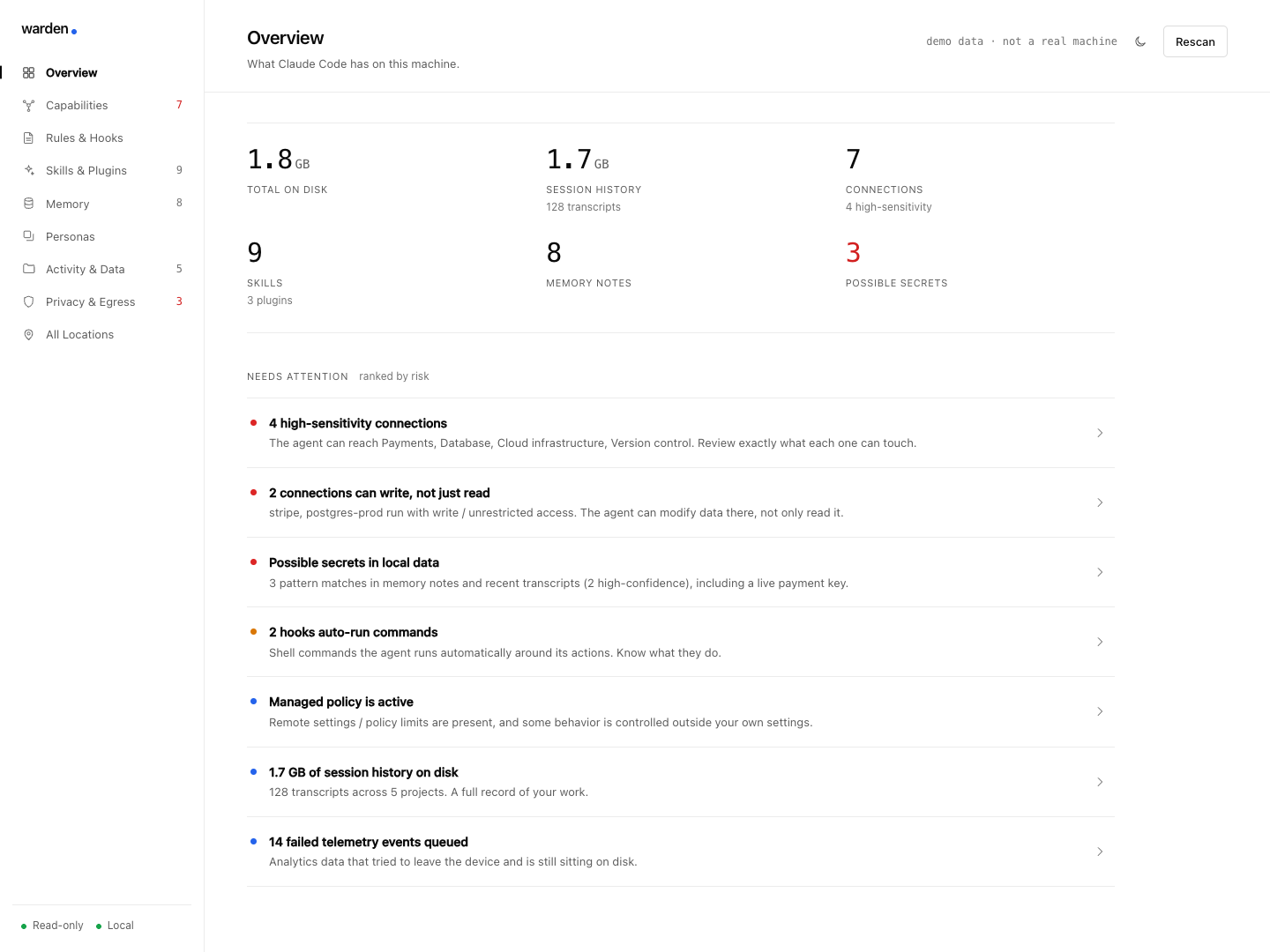
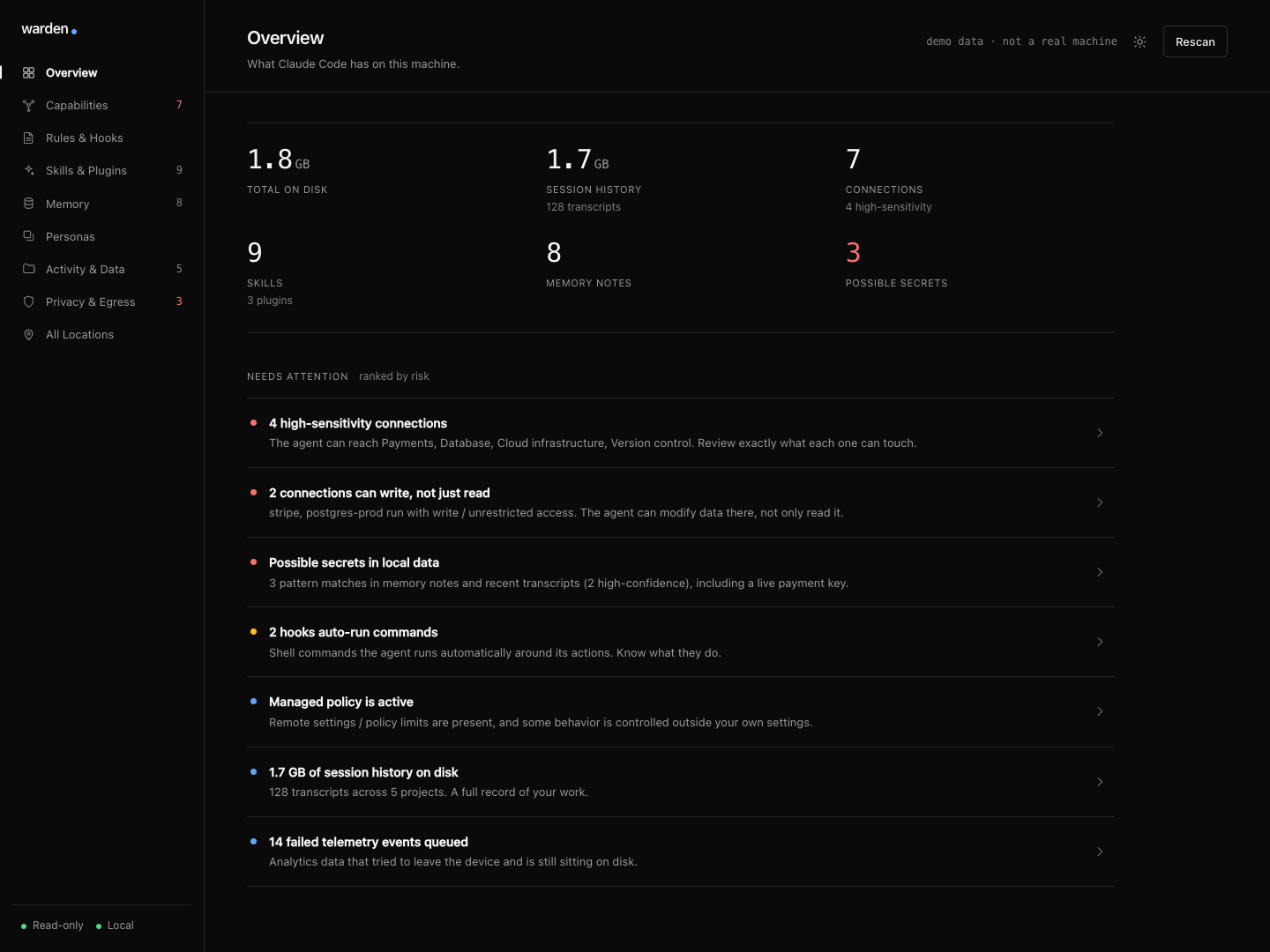
The overview, on demo data. Open the live demo to click through every screen.
Your agent's footprint is real, and scattered.
Claude Code is powerful, but everything it stores lives in deep, undocumented folders: ~/.claude.json, ~/.claude/, per-project memory, telemetry, backups. A technical person can dig through it. Almost nobody does.
What can this agent see, do, remember, and send from my machine? warden answers that in one screen.
Raw, scattered storage, turned into a picture you can read.
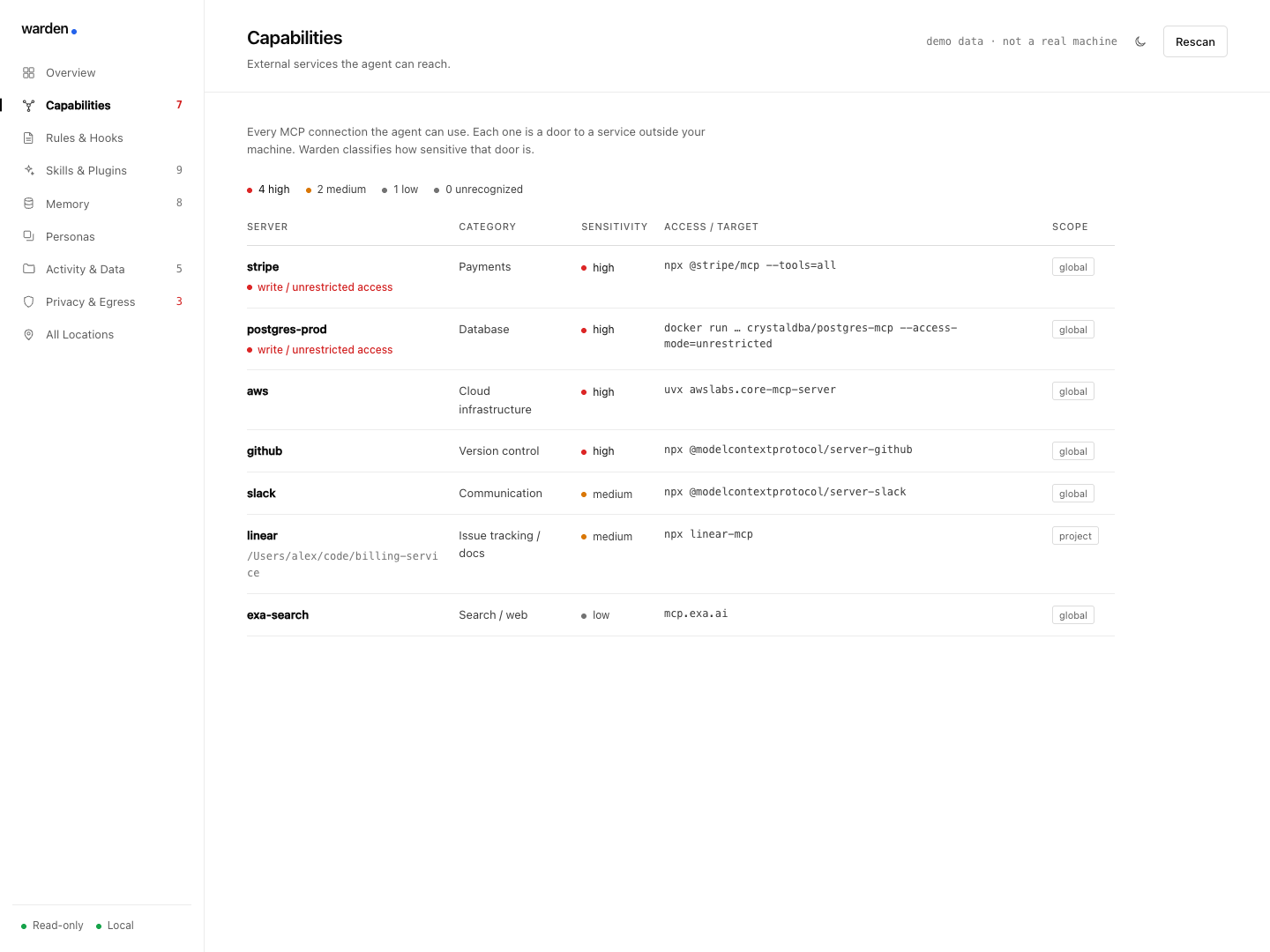
Every door the agent can open.
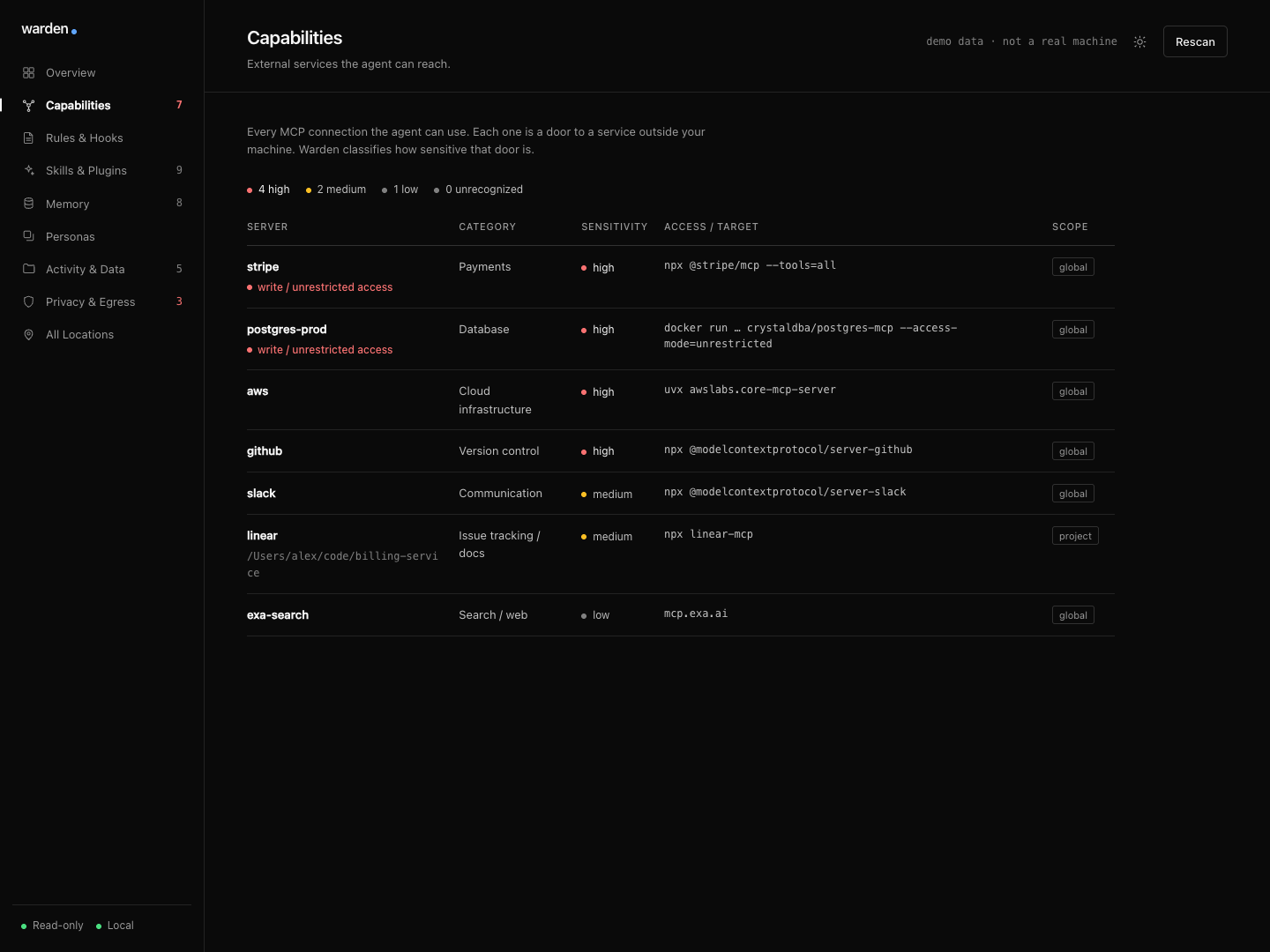
Each connection is classified by how sensitive it is, and flagged when it can write, not just read. Payments, a production database, cloud infrastructure: you see them at a glance, and which ones can change data.
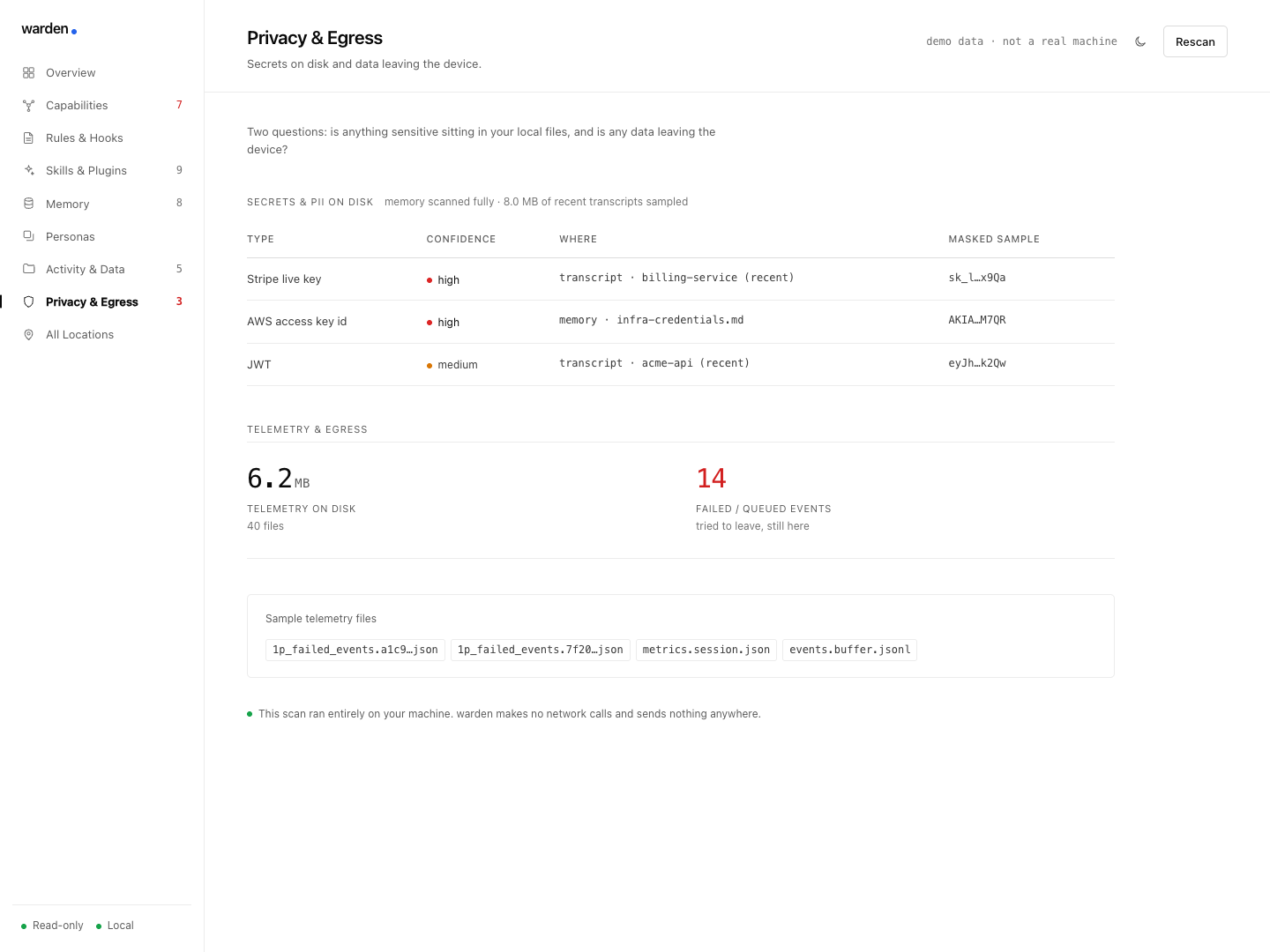
What's exposed, and what's leaving.
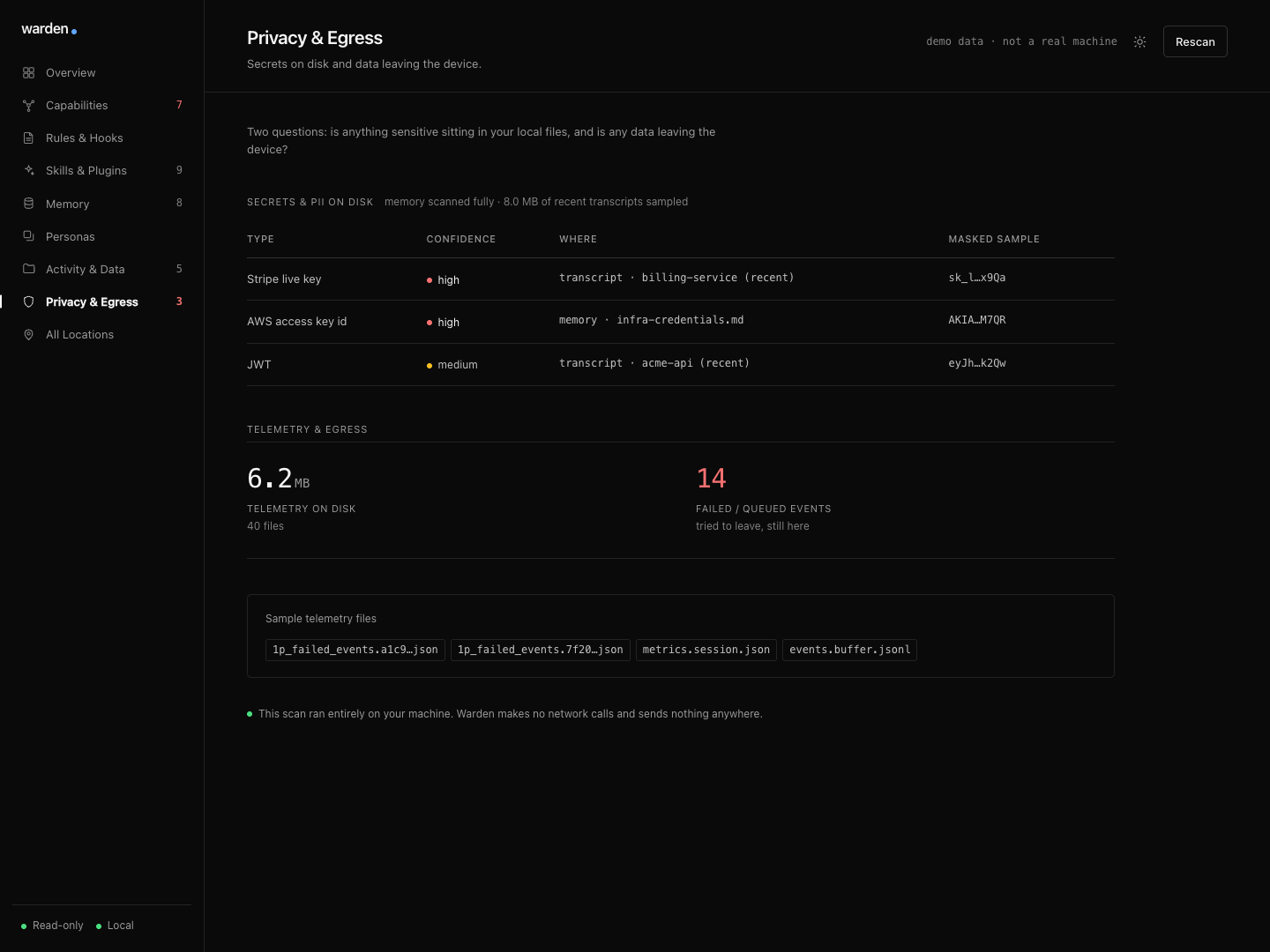
Secret and PII patterns found in your files and recent transcripts, always masked. Plus the telemetry sitting on disk, including events that tried to leave the device and are still here.
And every other place it looks.
- Overview
- A risk-ranked feed of what needs your attention.
- Rules & Hooks
- Your CLAUDE.md, permissions, and shell commands that run automatically.
- Skills & Plugins
- The installed abilities the agent can invoke.
- Memory
- Everything the agent has written down about you, across projects.
- Personas
- How your scattered config maps onto switchable per-context bundles.
- Activity & Data
- Session history and its footprint on disk, so you can reclaim it.
- All Locations
- A plain-English map of every place Claude Code stores something.
- Attention feed
- Raw findings ranked into "so what," not a data dump.
Runs on your machine. No account, no cloud, no build step.
npm start -- --demoExplore synthetic data, without touching your own machine.node bin/warden.js --port 4400Choose a different port.node bin/warden.js --no-openDo not auto-open the browser.It is a tool about trust, so it is built to earn it.
Read-only by default
warden reads and changes nothing until you turn on Controls. Even then it never hard-deletes your live data: changes move to a local trash you can restore, and emptying it is the only permanent delete, always confirmed by you.
100% local
Zero network calls. Nothing is uploaded, tracked, or phoned home. The scan runs entirely on your machine.
Zero dependencies
The whole tool is plain Node and vanilla web files. No build step, no framework, no supply chain to trust. Read the source; it is small on purpose.
Loopback only
The server binds to localhost and rejects any non-local request.
Secrets stay masked
When warden detects a key or token, it shows a masked sample so you can locate it, never the full value.
Ships as visibility. The direction is a control layer for AI agents.
Visibility
See everything, safely, read-only.
Control
Opt-in, reversible writes. Forget memory, reclaim disk.
Governance
Activity log, policy guardrails, secret and PII scanning, team persona sync.
Cross-agent
One control plane for every local AI agent, not just Claude Code.
See what your agent is holding.
The hosted demo runs on synthetic data, entirely in your browser. warden itself runs locally and reads only your own machine.